

                                                  SOLVING DIFFERENTIAL EQUATIONS OF ORDER ONE USING SEPARATION OF VARIABLES

                              There different ways to solve Differential Equations, and the common methods used in solving Differential Equations (or DE for short) are the following:
                              1. Separation of Variables
                              2. Equations with Homogeneous Coefficients
                              3. Exact Equations
                              4. Linear Equations of Order one
                              5. Other Methods
                                   a. Integrating Factor by Inspection
                                   b. Determination of Integrating factor
                                   c. Substitution as suggested by the equation
                                   d. Bernoulli's Equation
                                   e. Equation with Coefficients Linear in Two Variables
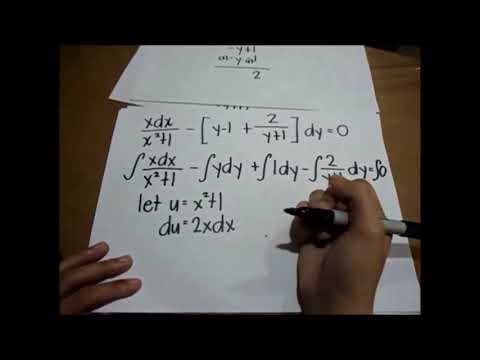
                              So, I'll be tackling about the method of Separation of Variables in my own understanding. Since I couldn't insert special symbols (but I'll use some symbols I could use), I'll be attaching the video me and my groupmates made regarding this topic if you wanted an explanation with visual aids.
                              Here's the video we made regarding this topic:

                              https://www.youtube.com/watch?v=F33RG8gJU-A&t=2s

                              Just go to that YOUTUBE link and you'll be directed to the video we made about this topic. So, let's begin...
                              Separation of Variables is the basic method for solving DE of equation one. Let's say you have a differential equation which is in the form of:
                              M(x,y)dx + N(x,y)dy = 0
                              The first term, M(x,y)dx is a term that contains a function M(x,y). M(x,y) is a function with two variables, "x" and "y"
                              For example:
                              (3xy-6y)dx
(2xy+4x)dx
                              The second term, N(x,y)dy is a term that contans a function N(x,y)dy. N(x,y) is also a function with two variables, "x" and "y"
                              You can use separation of variables method if you can reduce M(x,y)dx + N(x,y)dy = 0 to A(x)dx + B(y)dy = 0
                              Original Form: M(x,y)dx + N(x,y)dy = 0
Reduced Form: A(x)dx + B(y)dy = 0
                              In the reduced form, the first term will contain a function with only one variable, which should be "x" and the second term will contain a function with only one variable, which should be "y"
                              It is not necessarily a function of x or y, but rather a function with respect to its differential. Say you have DE of (3uv-6u)du + (2uv-4v)dv = 0. now, imagine "x" and "y" are the variables used in the DE, so let's say u = x and v = y, then you can rewrite the equation as (3xy-6x)dx + (2xy-4y)dy = 0. So now, there you have M(x,y)dx + N(x,y)dy = 0 and reduce it to A(x)dx + B(y)dy = 0.
                              But that'll take you some time to solve it, so rather than replacing the variables with x and y, you can just go directly. And reduce the given DE.
                              Too much with how to reduce, let's talk about the Separation of Variables method. There are four steps in solving DE using Separation of Variables.
                              Step one: Analyze
Of course, you'll always have to analyze before solving any mathematical or science problems but, what I mean here is you'll analyze the equation if you can reduce it, and how you're going to reduce it.
                              Step two: Reduce
To reduce the original equation to the reduced form, we will multiply the original equation with an integrating factor.
                              What is the integrating factor? The integrating factor is the factor that will reduce the Original equation: M(x,y)dx + N(x,y)dy = 0 to the Reduced form: A(x)dx + B(y)dy = 0
                              Step 3: Integrate
Once you reduced the equation, you can now integrate and will be able to get the final answer.
                              Step 4: Simplify
Sometimes you'll get an answer with denominators, and I hate seeing final answers with denominators so, I added this final step which is to simplify.
                              Example Problem: Find the solution of the DE, (3vu-6v)du + (2uv-4u)dv = 0
                              Step 1: Analyze
                              (3vu-6v)du + (2uv-4u)dv = 0
                              If you analyze the following equation, you will notice that both the first and the second term is factorable, so, let's factor the first term first.
                              3v(u-2)du + (2uu-4u)dv = 0
                              The common factor in the first term is 3v. Now, let's factor the second term.
                              3v(u-2)du + 2u(u-2)dv = 0
                              The common factor in the second term is 2u. And now, the first term has factors (3u) and (v-2) which is in terms of different variables "u" and "v" and same with the second term, it has factors (2v) and (u-2) which is in terms of different variables "u" and "v" we can't integrate it yet, because we still haven't reduced it, let's proceed to step 2.
                              Step 2: Reduce
                              3v(u-2)du + 2u(v-2)dv = 0
                              We need to remove 3v in the first time and place it in the second term, and we will need to remove 2u in the second term and place it in the first term. In order to do that, we will multiply the whole equation with 1 over (3v)(2u) or in symbolic form 1/(3v*2u), and it is what we call, the integrating factor.
                              [3v(u-2)du + 2u(v-2)dv = 0]* [1/(3v*2u)]
                              Multiplying it will give us the reduced form
                              [(u-2)/2u]du + [(v-2)/3v]dv = 0
                              Now, we reduced the original equation. And we can now integrate.
                              Step 3: Integrate
                              [(u-2)/2u]du + [(v-2)/3v]dv = 0
                              Let's integrate the first term first.
                              (1/2)u - (1/2)(2lnu) + [(v-2)/3v]dv = 0
                              Now, let's simplify the first and the second term.
                              (1/4)[u^2] - u + [(v-2)/3v]dv = 0
                              Let's integrate the third term.
                              (1/4)[u^2] - u + (1/3)v – (1/3)2lnv = 0
                              Let's integrate the "0" in the right hand side of the equation.
                              (1/4)[u^2] - u + (1/3)v – (2/3)lnv = C
                              Step 4: Simplify
                              Now, let's multiply the whole equation by twelve, since it's the LCM of 1, 3 and 4.
                              [(1/4)[u^2] - u + (1/3)v – (2/3)lnv = C]*12
                              3u^2 – 12u + 4v – 8lnv = 12C
                              C is an arbitrary constant, aboslute constant times arbitrary is arbitrary, therefore the final answer will be.
                              3u^2 – 12u + 4v – 8lnv = C
                              For questions, you can message me or comment below. And kindly click vote if you find this helpful. For suggestions, please comment below. I hope I helped you guys.

ESTÁS LEYENDO
Differential Equations (Notes, Lecture, and Examinations)
No FicciónThis book contains the compilation of our notes, lecture notes and articles about Differential Equations. We are publishing this book to share our understanding about the subject matter. Please, kindly leave a vote if you find this book helpful. Tha...
